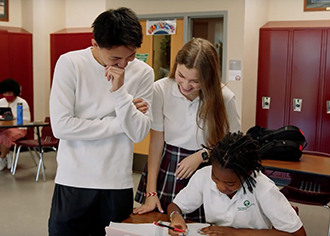
The Lower School years mark significant physical, cognitive, and emotional growth. Children become more aware of themselves and the world around them. At ISM, we provide an environment that helps students become confident in their identity and surroundings. We also work with students to develop a positive attitude towards learning, after which the foundation for academic achievement is laid.
We accomplish this by:

Questioning
Students learn to not only ask questions, but to listen to the questions of their peers.

Sharing
Students learn to share their opinions and ideas as well as listen to those of their classmates. They learn to consider and evaluate differing perspectives and opinions.

Structured Curriculum and Assessments
The pacing that a SABIS® school offers, keeps the lessons focused and moving forward. Regular assessments are like check-ins to see that the concepts are being mastered, so the students can continue to move ahead in the advancement of their knowledge.

Social Emotional Learning
Character building, respect, and kindness are built into each classroom at a level appropriate for that age group. We believe in educating the whole student, and in helping them to become confident, engaged and civically minded citizens with high ethical and moral values.
Previous
'
Awards & Recognition:

Minnesota’s Best Private School — What It Means for Your Child
ISM is proud to be recognized by Niche.com as the #1 Private K–12 Schools in Minnesota for the past four consecutive years, and among the Top 50 Private K–12 Schools in the U.S. Read the full article here!
In addition, the Star Tribune’s Minnesota’s Best Awards honored ISM with gold in six categories, including Best High School and Best Preschool for the past three years. Read the full article here!
For families, this means:
- Proven academic excellence from preschool through grade 12.
- A world-class SABIS® curriculum that builds curiosity, creativity, and confidence.
- Supportive teachers and small class sizes that help every child feel seen and supported.
- A school recognized nationally and locally for strong, consistent results.
AP® Honor Roll & Advanced Academic Recognition
For the second year in a row, ISM is proud to have earned Platinum Distinction on the AP® School Honor Roll, placing us among the top 7% of qualifying schools nationwide and one of only 11 in Minnesota. Read the full article here!
This distinction means your child will:
- Have access to rigorous, college-preparatory courses.
- Receive personalized support to excel academically.
- Be part of a school that consistently prepares students for college success and beyond.
Curriculum Highlights:
English
Students are building reading comprehension and oral fluency while developing their understanding of grammatical structure and language in these levels. They practice expressing ideas and facts with proper composition while also working on penmanship. Furthermore, students are expanding their vocabulary and spelling skills.
Mathematics
Students will focus on essential concepts of Arithmetic involving the four operations of addition, subtraction, multiplication, and division. Also, topics such as place value, fractions, decimals, metric and standard measurement, money, time, and geometry are taught in a sequential manner from one grade to the next resulting in a solid mathematical foundation. Mastery of computational skills and problem solving techniques enables students to understand the more abstract concepts of Upper School math.
Social Studies
Focusing on history and critical thinking, the social studies curriculum introduces students in this age group to real people, past and present. At the earliest levels, children learn about what is most familiar - themselves and their families. As their environments expand, their studies include the community, and then the geography, history, and cultural diversity of various countries around the world.
Science
Students explore the world they live in and develop effective techniques for observing and testing nature. Following the international, national, and state education standards, ISM uses the SABIS® Exploring the World of Science program. Instruction is divided into three strands: Earth and Space, Life Science, and Physical Science. Through a number of interactive activities, students are encouraged to use scientific process skills, allowing the world of science to become both accessible and tangible for students.
World Language
The objective of the World Language Program in the Lower School is to help students attain proficiency in the language of study and gain an understanding of the history and culture of its people. Learning a world language is an intrinsic part of ISM’s curriculum. Currently, Spanish and French are offered at the school. The comprehensive language curriculum consists of the four skill areas of language learning: listening, speaking, reading, and writing. Language acquisition begins with vocabulary taught orally and structures learned inductively and reinforced with developmentally appropriate grammatical concepts. Qualified teachers with native speaker fluency teach World Language classes at ISM.
Additional Subjects
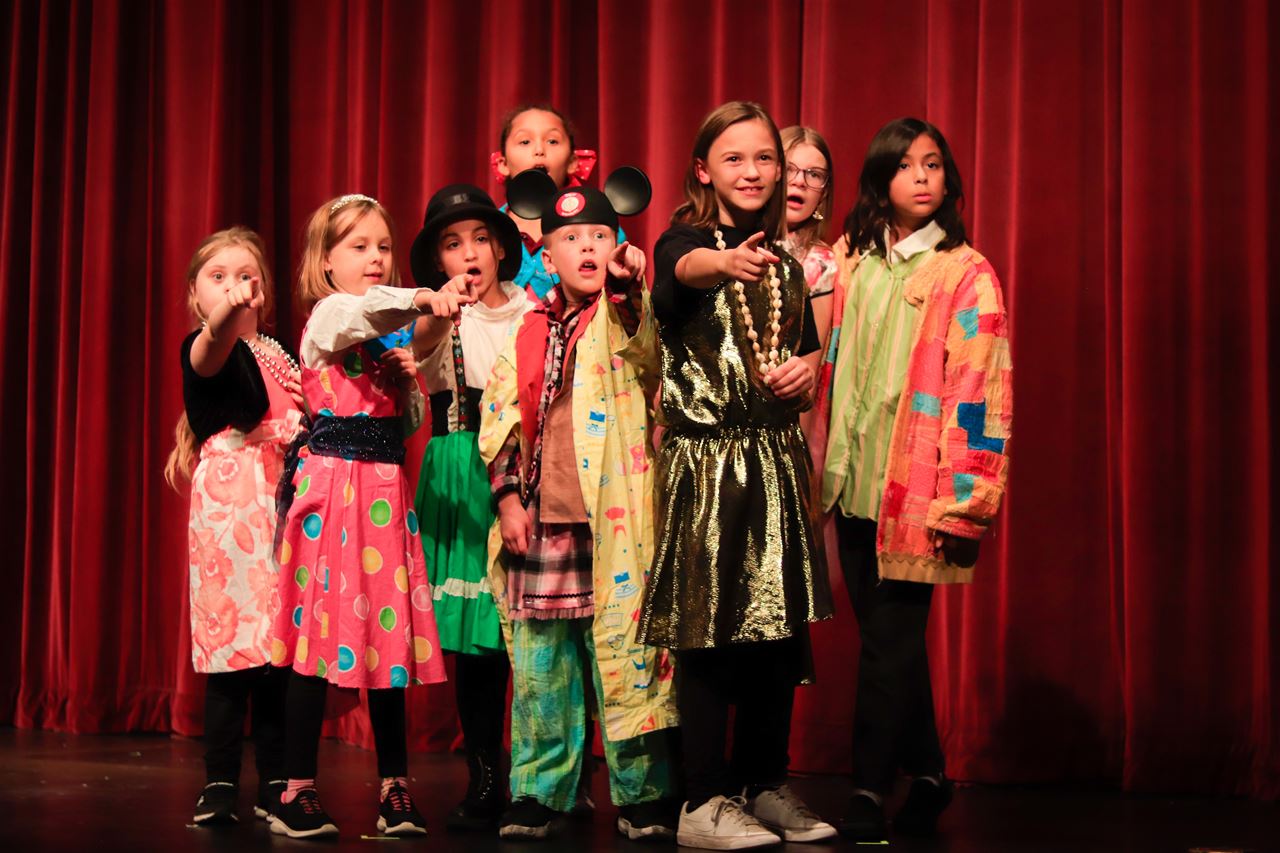
The ISM Lower School program balances academic progress with developing social, physical, and emotional maturity by engaging students in art, music, computer, drama, library, and P.E. classes, which also contribute to developing a healthy, eager, and happy child.